Tutorial 4 · Sessions via MCP
Goal: give an agent (like Claude Code itself) pausable sandboxes as tools —
one session_run call creates a worker if missing, wakes it if parked, and
runs the command. Lifecycle is never the agent's job.
Prereq: the one-time setup (you need the API key; the CLI is optional here).
The control plane serves MCP at https://beta.barista.sh/mcp, bearer-
authenticated with your API key. Tools:
| Tool | Args |
|---|---|
session_run |
name, command (argv) — creates from template (or the platform default) if missing, wakes if parked |
session_exec |
name, command (argv) — exec only, no create |
session_create |
name (+ template, or image [+ digest], command) |
sessions_list |
— |
session_delete |
name |
worker_invoke |
worker, command (argv) — runs a defined worker once and returns a handle instead of holding the connection; idempotency_key makes a retry resume rather than re-run |
worker_invocation |
worker + either invocation (the id from the handle) or idempotency_key — reads an invocation; never starts one |
There are deliberately no pause/resume tools: sessions auto-park when idle
and session_run/session_exec wake them — parking is the platform's job,
not the agent's.
Protocol revisions
Two are served, and the endpoint reads which one you want from
MCP-Protocol-Version on each request:
2025-06-18— what you get if you send no version header. Unchanged.2026-07-28— no handshake, noMcp-Session-Id, and per-request carriage. Under it, every request must also carryMcp-Method(the JSON-RPC method) and, where the call names an operation,Mcp-Name(the tool). Both are required: a request that omits them, or whose headers disagree with its body, is refused with400rather than routed from the body — a header that is optional in practice is a client that breaks against the next server it meets.tools/listalso returnsttlMs,cacheScopeand acacheKeyyou can send back to be told your copy is still current without re-receiving it.
A revision the endpoint does not serve is refused by name, so you never silently get behaviour you did not ask for.
worker_invoke's handle is ours, not the revision's: 2026-07-28 defines no
async task model on the core request path, so the handle travels inside an
ordinary tool result and works under either revision.
Add it to Claude Code
claude mcp add --transport http barista https://beta.barista.sh/mcp \
  --header "Authorization: Bearer <your-api-key>"
Then just ask, in Claude Code:
Run
cat /tmp/cin a session calleddemo(create it from the counter template if it doesn't exist), wait a bit, and read it again.
Claude calls session_run twice — the first call materialises the worker;
if it idles and parks in between, the second call wakes it and the count has
survived.
Or drive it directly with JSON-RPC
The same calls, over plain HTTP — useful for any MCP client or a quick check:
KEY=<your-api-key>
mcp() { curl -s https://beta.barista.sh/mcp \
  -H "Authorization: Bearer $KEY" -H 'content-type: application/json' \
  -d "{\"jsonrpc\":\"2.0\",\"id\":1,\"method\":\"tools/call\",\"params\":$1}"; }

# one call: create-if-missing (from a template — tutorial 7), wake-if-parked, run
mcp '{"name":"session_run","arguments":{"name":"demo","template":"counter",
      "command":["cat","/tmp/c"]}}'
# {"result":{"content":[{"type":"text","text":"{\"name\":\"demo\",\"exit_code\":0,\"stdout\":\"2\",…}"}],"isError":false}}

# …let it idle-park, then the same call again — it wakes and the count survived:
mcp '{"name":"session_run","arguments":{"name":"demo","command":["cat","/tmp/c"]}}'
# … "stdout":"17" …

mcp '{"name":"session_delete","arguments":{"name":"demo"}}'
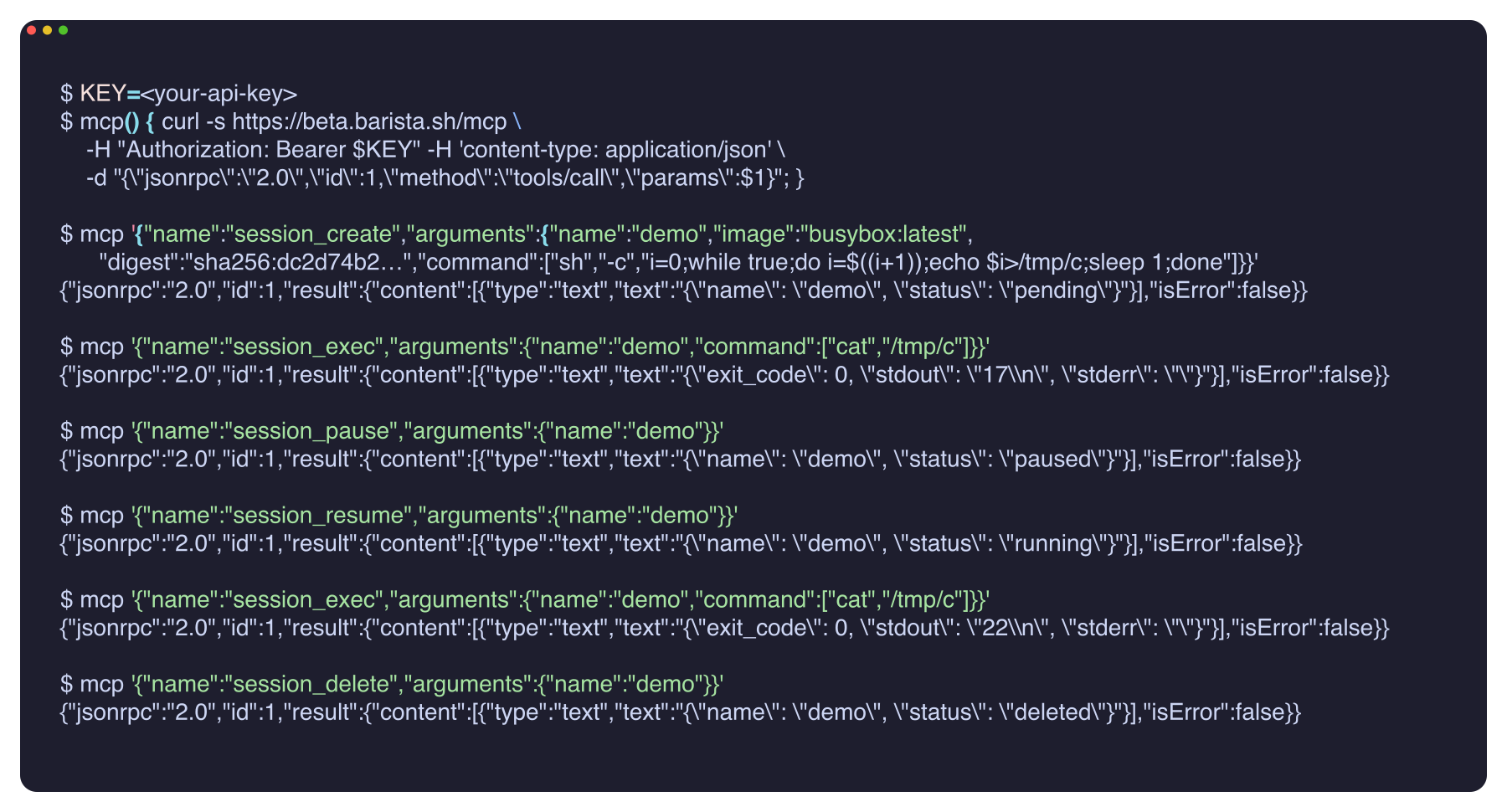
A verified run (pre-session_run, with the then-manual pause/resume tools)
went exec 17 → pause → resume → exec 22 — the same memory-preserving park,
now automatic:
What this gives you
An agent (Claude Code, or anything speaking MCP) can now provision a real, hardware-isolated KVM sandbox, run commands in it, and freeze/thaw it with memory — its own pausable workspaces, as tools. Combine with the Claude Code session tutorial to have an agent that manages other agent sessions.